

This website uses cookies to ensure you get the best experience on our website. Learn more
[New Research] Is Your Password Naughty or Nice?
Table of Contents

Last updated on November 19, 2026
The holiday season is here, bringing familiar traditions and plenty of Christmas cheer. But there’s one place you might not expect to find Santa and Rudolph: people’s passwords.
When creating or resetting passwords, people often turn to words and phrases that are easy to remember. Popular events and celebrations, from the World Cup to Christmas, provide plenty of inspiration. However, memorability doesn’t necessarily equal security, particularly when attackers can use personal interests and predictable patterns to guess passwords.
To see how often these festive choices appear, the Specops research team analyzed more than 260 million passwords exposed in 2026. This research coincides with the addition of over 460 million unique compromised passwords to the Specops Breached Password Protection service, taking the total to over 6.5 billion records. These passwords are sourced from infostealer breaches, as well as our honeypot network and other threat intelligence sources.
What 260 Million Breached Passwords Reveal About Holiday Security
We examined the frequency of 26 holiday-related and seasonal terms appearing in breached passwords identified throughout 2026. These ranged from familiar Christmas references, such as “santa” and “rudolph”, to winter-themed words and seasonal celebrations.
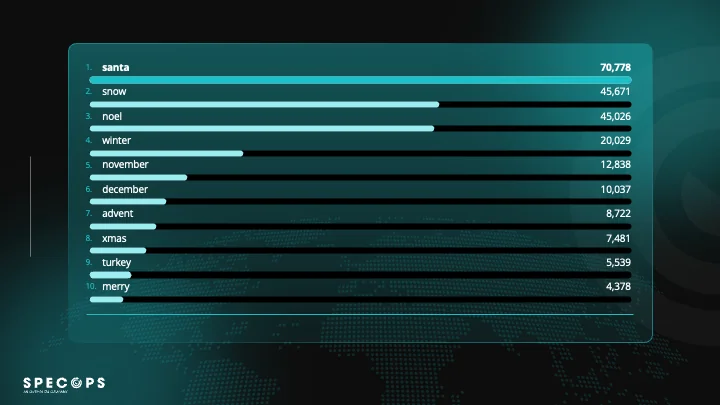
We found more than 242,000 instances of holiday-related passwords from our dataset. This includes variations of the base terms, such as “sN0w” and “Chr1sTmas”.
The Most Common Holiday-Related Terms in Breached Passwords
| Holiday Term | Occurrences |
|---|---|
| santa | 70,778 |
| snow | 45,671 |
| noel | 45,026 |
| winter | 20,029 |
| november | 12,838 |
| december | 10,037 |
| advent | 8,722 |
| xmas | 7,481 |
| turkey | 5,539 |
| merry | 4,378 |
| yule | 3,400 |
| christmas | 2,796 |
| snowman | 2,039 |
| jingle | 1,257 |
| rudolph | 999 |
| sleigh | 463 |
| reindeer | 371 |
| santaclaus | 317 |
| blackfriday | 195 |
| thanksgiving | 97 |
| menorah | 74 |
| mistletoe | 73 |
| kwanzaa | 16 |
| hanukkah | 14 |
| fatherchristmas | 10 |
| cybermonday | 7 |
The results reveal some clear favorites, along with a few surprises:
- Santa was the most common term by a considerable margin, appearing 70,778 times in the dataset. That’s more than 25 times the occurrences of “christmas” itself, which appeared just 2,796 times.
- Calendar-related terms also featured prominently. “November” appeared 12,838 times, while “december” recorded 10,037 occurrences. Both ranked above more obvious festive references, including “advent” (8,722), “xmas” (7,481), and “merry” (4,378).
- The abbreviated “xmas” appeared more than twice as often as “christmas”. Other recognizable Christmas references were less common than you might expect, with “rudolph” appearing 999 times, “reindeer” 371 times, and “mistletoe” just 73 times.
Of course, not every occurrence necessarily reflects a festive password choice. Words such as “snow”, “noel”, and “november” also have meanings unrelated to the holidays. Nevertheless, the findings offer an interesting glimpse into the words and seasonal references that appear in compromised passwords.
Why These Passwords Create Risk
Predictable Construction
Attackers know that people tend to choose familiar words when creating passwords. Password cracking tools can test dictionaries of common terms alongside predictable variations, including capital letters, character substitutions, and numbers. Adding “123” or an exclamation mark at the end of a term might satisfy basic complexity requirements, but it doesn’t necessarily make the resulting password difficult to crack.
Compromised Passwords and Reuse
The bigger concern is that these passwords have appeared in breached password datasets. Once a password has been exposed, attackers can use it in credential stuffing attacks, testing stolen login details against other accounts in the hope that the same credentials have been reused.
While strength depends on the full password, not the presence of a particular word, predictability does make it easier to guess. Previously compromised passwords also pose a risk regardless of how complex they appear. Research carried out by Specops earlier in 2026 revealed that 19% of passwords compromised in a one-month period satisfied typical enterprise complexity requirements; strength is no defense if an attacker has access to the password.
For organizations, the challenge is identifying which employees are using weak or compromised passwords. And in Active Directory environments, that isn’t always straightforward.
What Organizations Can Do Today
This data serves to highlight the importance of following compliance and reset rules in line with NIST 800-63B, as well as regulations like CJIS and Cyber Essentials. When creating passwords, users will tend towards short and easy to remember passwords. As shown in this data, often people will try to use memorable terms, such as holiday-related words.
A good starting point for judging your current password health is to run an audit of your Active Directory. Specops Password Auditor is a free tool that performs a read-only scan of your Active Directory, highlighting any compromised or identical end-user passwords. You’ll get the results in an easy-to-understand interactive report, including weak policies, compromised passwords and stale or inactive accounts.
This research coincides with the addition of over 4.6 million new records to the express list (bringing the total to more than 1.1 billion records) used by Specops Password Auditor, so there has never been a better time to understand your current exposure. Download your free auditing tool here.
Continuously Block Weak and Compromised Passwords
Password audits help identify existing risks, but preventing employees from using weak or compromised passwords in the first place is just as important. Microsoft’s native password policies provide basic complexity requirements, including minimum character lengths and combinations of uppercase letters, numbers, and symbols. However, these rules don’t stop employees from choosing predictable passwords or reusing credentials that have appeared in previous data breaches.
Specops Password Policy with Breached Password Protection delivers that security, so organizations can continuously protect themselves against over 6 billion known unique compromised passwords. The service is updated daily using our research team’s threat monitoring data collection systems to defend networks against password attacks happening right now.
Specops Password Policy also allows organizations to robust policies aligned to sector-specific regulations, with dynamic feedback guiding users to create strong passwords they can easily remember. An unlimited custom dictionary of blocked words also ensures users can’t choose familiar or organization-specific terms in password creation, protecting against targeted attacks.
If you’re interested in seeing how this could work for your organization, book a demo with Specops today.
Last updated on November 19, 2026